The Wet Paint Sentence: Why "This Is Not About Money" Always Is
Syracuse University is sunsetting 93 academic programs after a two-year portfolio review. Provost Lois Agnew opened the announcement with this: "I want to emphasize this was not a cost-cutting exercise, and it was not aimed at eliminating departments or people."
That is a Wet Paint sentence.
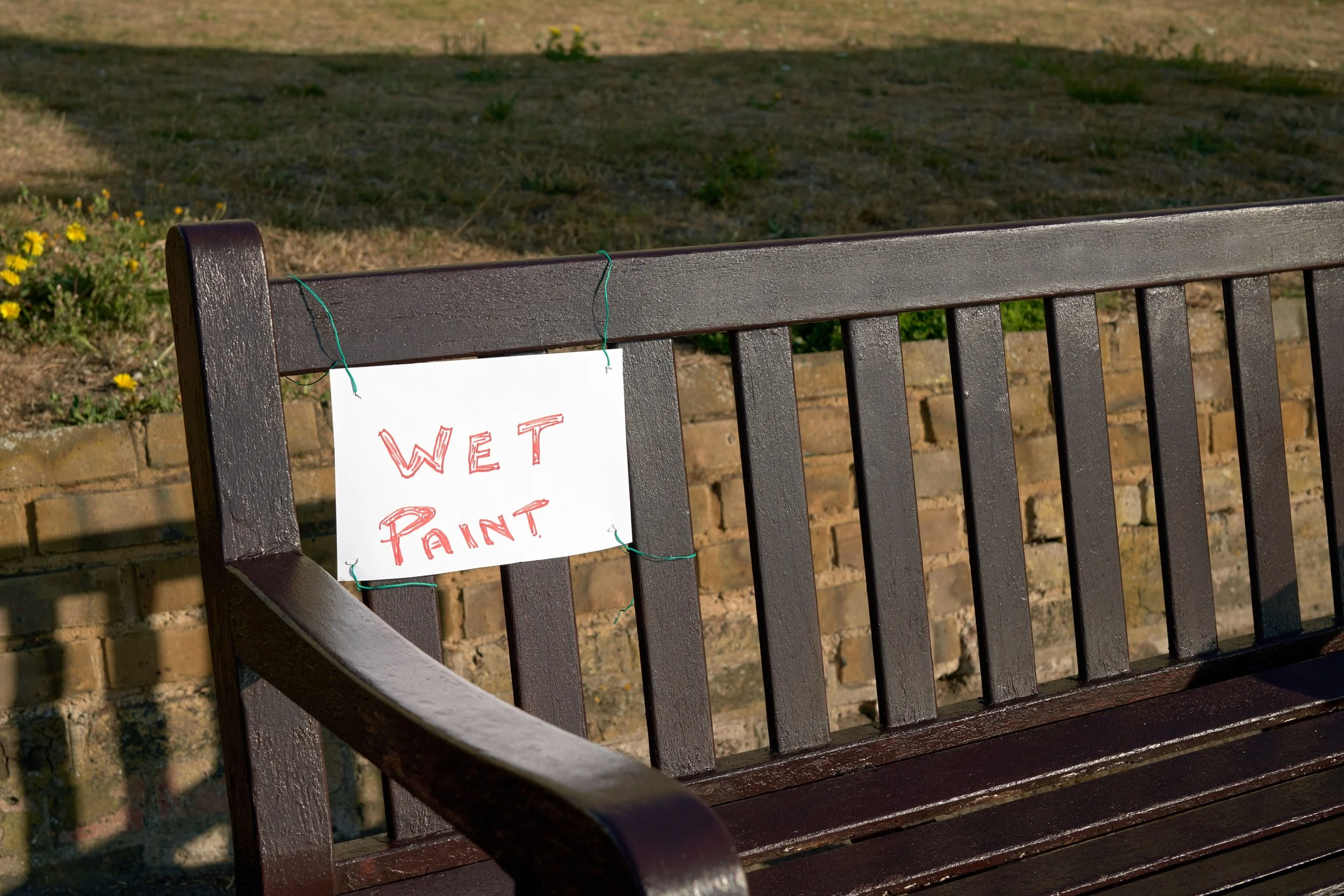
You know the one. You’re out for a walk. There is a small handwritten sign taped to a bench. WET PAINT. You were not thinking about the bench. Now you are. You’re drawn to touch it, just to see. The sign did not protect the bench. The sign is the reason you noticed it at all.
The provost's opening sentence works the same way. Until she told me the decision was not a cost-cutting exercise, I was not thinking about cost-cutting. Now I am.
Neither is any parent writing a tuition check, any trustee reading the release on Sunday night, or any reporter with a thousand-word hole to fill on a slow Tuesday.
For the record, I went to Syracuse. I am a proud alum. I am rooting for the place. This is the post a friend writes when a friend has spinach in their teeth. You do not write it because you want the friend to look bad. You write it because one sentence may do more damage to the Syracuse announcement than any of the 93 program cuts it was trying to defend.
I Know What That Sentence Does Because I Have Written It
A decade of corporate communications at MBNA and Bank of America will teach you a few things. One of them is that every executive wants to skip the uncomfortable part of a hard announcement and go straight to the noble part. The Wet Paint sentence is the bridge they reach for. It feels polite. It feels like it buys room.
It doesn't.
I’ve been asked to draft these sentences. I have talked clients out of them. I have also lost the argument a few times and watched them go out into the world over my objection. Those are the ones I still remember. There is a specific kind of email a CEO gets the Monday after a Wet Paint sentence lands wrong, and once you have read one of those you don’t want to read another.
Same Sign, Different Bench
Walk this vocabulary across higher education and the pattern is easy to spot. West Virginia University runs an "Academic Program Portfolio Review" built around student demand and mission alignment. Penn State has been flagging "duplicative and under-enrolled" programs across its branch campuses. Inside Higher Ed, Higher Ed Dive, and a fleet of consultancies have turned "strategic alignment" and "program mix optimization" into a shared dialect.
None of those phrases are lies. They're often accurate. But readers have been trained to mentally translate them as "money" after a decade of watching the sector contract. The dialect has a job. The job is to make the decision sound clinical. The side effect is that the clinical frame reads as a cover story, whether it is one or not.
If you are a tech founder or a financial services executive, and you are thinking "sure, but that's a higher-ed problem," pull up your last board letter. Pull up the memo you sent when you closed the Boston office or sunset the compliance module that never quite worked.
I will bet you at least one of those documents contains a sentence that begins, "This decision was not driven by cost considerations." Or, "While some have characterized this as a pullback, I want to reframe it" or "We're optimizing the product portfolio to align more closely with customer demand." Same sign. Different bench. Your board is reading it the same way the Syracuse trustees will read the provost.
Read any of those sentences aloud at a real meeting (what I have been calling the Conference Table Test for years), and watch what happens. The CFO looks up. The board chair flips to the financials. The general counsel pencils a question in the margin. All of them are pointing at the exact thing the sentence was trying to hide.
The Fix Is Not Subtle
A difficult financial decision gives you two honest ways to communicate it, not three. The first is to not talk about the money at all, which your board or your regulator will usually not let you get away with. Rule it out for most situations.
The second is to put the money on the table first, in one clean sentence, and then explain the discipline that followed from it. Name the pressure. Name what you did about it. In that order. What blows up is trying to deny the money and explain the discipline in the same breath. You do not get both.
Syracuse, had it wanted to, could have written this: "Rising costs and shrinking enrollment are real, and every serious university in America is facing both. We decided to make ours the occasion for a two-year review of which programs still serve our students and our mission, and we are sunsetting the 93 that no longer do. Yes, it saves money. It also leaves us with a stronger academic portfolio." That version admits the money and gets credit for the discipline. The original version doesn't.
A tech founder version of the same trap sounds like this: "We are executing a strategic repositioning of our go-to-market motion to better align with the highest-value segments of our customer base." Read that aloud at a real meeting and watch what happens. The CFO reads it twice and pulls the 10-Q. The board chair pencils a question in the margin. Both of them are now asking the question the sentence was trying to bury.
Here is the version that does not get a sharper question at the next meeting: "Our mid-market renewal slipped hard last year. We spent a quarter trying to understand why. The honest answer is we were selling to a segment we were not built to serve, so we are pulling back and refocusing on the institutional buyer who has been driving most of our growth. Yes, that means a smaller near-term pipeline. We think it means a stronger one by Q4."
A board member reads that version and nods.
The Signal Underneath the Wet Paint
Anyone running an online school, a certificate business, a bootcamp, or a corporate learning-and-development shop hopefully read the Wet Paint sentence twice.
When a university sunsets 93 programs, some subsets are programs with no demand. Dead weight. Fine. But another subset are programs where the demand may be real and the economics were not. A $60,000-a-year university cannot profitably serve a program with 14 students and a four-semester delivery cycle. That does not mean the 14 students did not exist. It means the 14 students, plus the next 1,400 like them, are walking around with a need that no one at Syracuse will meet next fall. The provost's announcement tells you which needs have just opened up.
If I ran a certification shop or a bootcamp, I would pull every Syracuse cut list I could find and ask three questions about each sunset program.
Was there real enrollment as recently as three years ago?
What was the career outcome those students were chasing?
And could I deliver 70 percent of the value in 10 percent of the time at a tenth of the price?
Syracuse called this a portfolio review. The right cert provider should read it as a shopping list. The comms failure and the market-signal failure are the same failure.
The Test You Can Run Before Lunch
Pull up the last three things your company sent to an outside audience. A board letter. An investor update. A layoff memo. An internal all-hands email that leaked (they all leak eventually, and if yours has not leaked yet, congratulations on the new hire).
Search each one for any sentence that starts with "This is not," "This decision was not," "Let me be clear, this is not," or "While some may characterize this as." If you find one, read the whole paragraph out loud. If the thing the sentence is denying is the first thing you thought of when you started the paragraph, you painted a bench and put a sign on it. Rewrite it so that the thing you were trying to deny comes first. Say it once. Say it clearly. Then explain what you did about it.
That is the Windex moment. You do not have to say more. You have to say the right thing first.
Find It In the Draft, Not the Headline
If your next board letter has a Wet Paint sentence in it, I would rather find it in a draft than in a headline. Send it over. I will read it the way a trustee reads it on Sunday night and tell you which bench you just painted.