The Preface, the Pause, and the Throwaway Reply
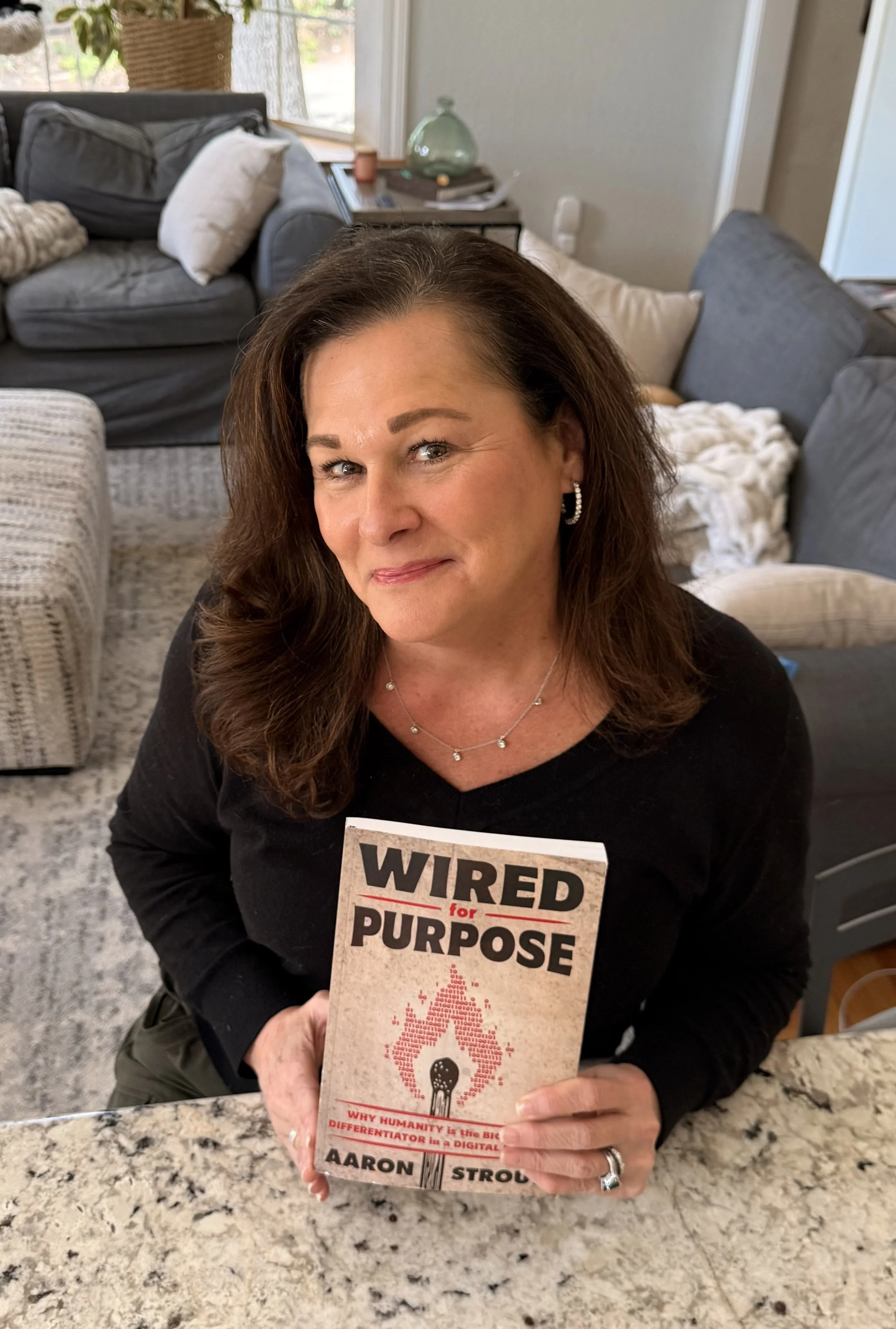
Melanie Strout wrote the Preface for her husband’s new book, “Wired for Purpose”
Most executive memoirs follow a convention so consistent that it disappears into the form.
The author writes the preface in their own voice, explaining why the book exists. The publisher commissions a foreword from a known figure: a former boss, a respected peer, a celebrity endorser. The author's spouse, if mentioned at all, gets thanked in the acknowledgments. Co-authored books are explicitly co-authored.
Aaron Strout, the former chief marketing officer at Real Chemistry, didn't do that.
When he published Wired for Purpose this spring, the preface went to his wife, Melanie. The slot reserved for the author's own voice. It was an interview transcript. His publisher had spoken with her for an hour. The transcript, edited lightly, became page 5.
I read the preface before I read anything else in the book. I told Aaron when we spoke that his wife could write. He laughed and said something I've been thinking about ever since.
"The preface, if we're being honest, is my favorite part of the book."
In a business publishing category that runs on the assumption that the executive's own voice is what readers want, Aaron made the opposite bet. The reader who picks up Wired for Purpose first meets Aaron through Melanie. Her voice carries the register the rest of the book has to live in. Warm. Observant. The view from across the breakfast table.
The author's voice arrives in the next chapter. Practical. Earned. The view from inside the room.
Both voices work. Together, they tell you more about him than either would alone. The structural choice to put Melanie first is, as far as I can tell, almost unheard of in business publishing.
There's a reason Aaron could make that choice. It's the same reason he's a good interviewer.
The audiobook self-audit
Aaron recorded the audiobook for Wired for Purpose a few weeks before we talked. Because he's a podcaster, he wanted to read it himself. The process required him to listen back to almost 20 years of his own interviews on archive.org. The We Show. Quick & Dirty. Live from Stubb's. What2Know. Hundreds of hours
What he heard was difficult.

Aaron Strout, author of Wired for Success
"There are a couple of times where someone might say, My dad died of cancer or my brother took his own life or whatever, and I missed it," he told me. "And I was horrified after the fact, like listening to that, realizing that I hadn't caught that because I had been so focused on whatever it was that I wanted to say next."
It got worse.
"The thing that hurt my heart the most was the throwaway replies that I'd have to people. Oh, I love that. Thanks. That's great. Let me move on to the next question."
A 57-year-old man, listening back to his own performing voice across two decades, found that the moments he should have caught were the ones he'd been least prepared for. He'd been focused on the next question. The guest had told him something hard. He'd said oh, I love that and moved on.
The Arrington pause
The lesson started earlier.
In 2006, Aaron recorded his first major podcast interview. The guest was Michael Arrington, the founder of TechCrunch. Aaron's podcast had 10 listeners. Arrington had no reason to say yes. He said yes anyway.
Forty seconds into the recording, Arrington asked Aaron to pause.
"He said, I sense that you're a little bit sort of nervous about this. I can hear it in your voice," Aaron remembered. "He's like, we're just two guys. Take a breath. We're going to just have a conversation."
The lesson Aaron took wasn't a technique. It was permission. Permission to stop performing. Permission to listen.
He spent the next 20 years building an interviewing practice on what Arrington gave him in those 40 seconds. By 2013, he had a coach (James Milosevic, who reframed feedback as a gift in a way Aaron still credits as the most important reframe of his career). By 2026, he had two decades of evidence on his own tape. By the time the audiobook session forced him to sit with all of it, he could hear what he hadn't heard at the time.
The Tape Room
I call this approach the Tape Room. It's the room a ghostwriter has to be willing to enter on behalf of the executive who hired them. The room where you listen to the interview you just recorded and notice the moments the executive moved past too fast. The mid-sentence pause when she got to the part about her father. The way he answered the question about the deal that didn't close before you finished asking it. The exact word he used when he meant something else.
The Tape Room is where good ghostwriting separates from bad. Bad ghostwriting takes the polished version of what the executive said and puts it on the page. Good ghostwriting hears what the executive almost said and writes that instead. I built a one-page guide to conducting one that you can download here.
You can't run a Tape Room if you're listening for your next question. You can't run a Tape Room if you're performing yourself. You can only run it if you've already done the work Aaron did in the audiobook booth, which is the work of sitting with your own voice and admitting what you missed.
What this means if you're paying someone to write for you
The version of you that survives scrutiny, whether from a regulator, remarks during an All-Hands Call, or a senior candidate reading your About page on the way to a competing offer, is the version observed from the other side of the table.
Your own voice will perform itself. It can't help it. Twenty years on a microphone will teach you that, if you listen back.
The person across the table from you is the one who hears the throwaway reply and remembers it. The person across the table from you is also the one who, if she's good at her job, can show you which throwaway replies are costing you deals.
Aaron Strout figured this out twice over. Once when he put Melanie on page 5. Again when he sat in the audiobook booth and heard himself, across 20 years of recordings, give the kind of throwaway reply a guest would catch but he didn't. Oh, I love that, thanks, let me move on to the next question.
The book is his. The voice that kickstarts earning its trust is hers.
That's the lesson.
I wrote a longer profile of Aaron Strout for RestlessUrban that gets at a different question. What it's like to walk away from a 14-year run at the top of a multibillion-dollar agency at 55. You can read it here. And the book review is here.